Library Services
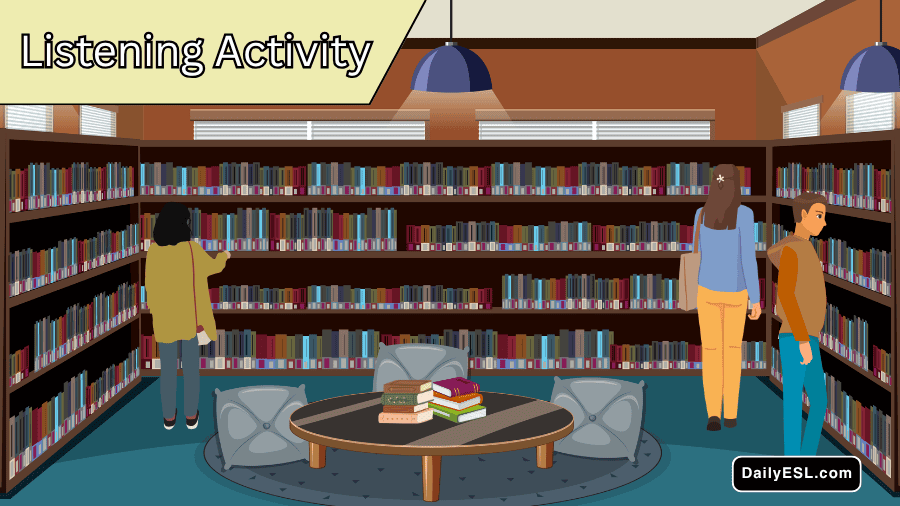
Pre-Listening
Is there a public library where you live? Do you visit the library?
Listen and Read
Listen to the recording, answer the questions, and then read along with the audio recording.
Listening Quiz
Select the best answer for each question, then press Check Answers.
Use arrow keys to choose between options within each question.
1. The man is looking for a book at the ________.
2. People can check out books for up to ______.
Recently, I needed to find a book for one of my classes at the university, but I didn’t know if the university library had it in their collection, so I went to the library website and searched for the book online. You can search the library database either by subject, title, and author, and the website will tell you if the book is checked in or check out by another patron. In my case, the book was still available, so I went to the library the next day and found it on the shelves using the library catalog number.
I then went to the circulation desk and checked the book out using my university ID card. In most cases, students and faculty can check out books for up to one month, and you can renew them if you still want to hang on to them. If you return them after that, then they’re overdue, and you have to pay a late fee. If you lose a book, then you have to pay the cost to replace it.
I often use the library and check out books instead of buying them if I can. Borrowing books can save you money in the long run.
Vocabulary and Expressions From the Audio
- collection (noun): in the context of a library, the complete set of books, materials, and resources that a library owns and makes available to its users
- The university library had an impressive collection of rare historical documents.
- database (noun): a large organized collection of information stored electronically that can be searched and accessed
- She used the library’s online database to find articles for her research paper.
- checked in (expression): returned a borrowed item to the library so it is available for others to borrow
- The book had just been checked in, so she was able to borrow it right away.
- check out (phrasal verb): to borrow a book or other item from a library by registering it at the desk
- He went to the circulation desk to check out three books for his research project.
- patron (noun): a person who regularly visits or uses a particular place or service
- The librarian reminded patrons that the library would be closing early on Friday.
- library catalog number (noun): a unique number assigned to each item in a library that indicates where it is located on the shelves
- She wrote down the library catalog number so she could find the book on the correct shelf.
- circulation desk (noun): the main service counter in a library where patrons check out, return, and renew books and other materials
- He brought his books to the circulation desk to have them checked out before leaving.
- faculty (noun): the teaching and academic staff of a school, college, or university
- Members of the faculty were allowed to borrow books for an extended period of time.
- renew (verb): to extend the borrowing period for a library item so it does not become overdue
- She called the library to renew her books because she hadn’t finished reading them yet.
- hang on to (phrasal verb): to keep or hold onto something rather than returning or giving it up
- She decided to hang on to the book a little longer and renew it before it became overdue.
- overdue (adjective): not completed, returned, or paid by the required or expected date
- He realized his library books were overdue when he received a reminder notice in the mail.
- replace (verb): to provide a new item in place of one that has been lost or damaged
- Since the book was too damaged to use, she was asked to replace it with a new copy.
- in the long run (expression): over a long period of time; when considering the final outcome rather than the immediate situation
- It’s worth developing good study habits now because in the long run, they will save you a lot of time and stress.
Discussion
How much do you use a library to do research and write papers as compared with using the internet? Is using books a better resource than using online information to write papers? Why or why not?
Online Investigation
More and more websites contain complete texts of famous literary works, and thus, make it easier for students to read well-known books. Choose one of these works of literature, and see if you can use the internet to find the complete work:
- Moby Dick by Herman Melville
- The Hound of the Baskervilles by Arthur Conan Doyle
- Red Badge of Courage by Stephen Crane
- The Adventures of Tom Sawyer by Mark Twain
- Twenty Thousand Leagues Under the Sea by Jules Verne
Online Listening Practice (from www.esl-lab.com):
- Library Tour: Listening Conversation